01
One capture session
A few minutes of video and audio of your professor, recorded on a phone in a quiet room. That is everything we need from their calendar.
We turn a syllabus into a finished video course, taught on screen by your own faculty, in the languages you need. No film crew. No studio. No recurring platform fee.
Not one sample repeated. A seminary lecture, a clinical nursing class, a general education course carrying a full slide load, and the same class delivered in Korean. Choose a course and it opens in full: the class, its chapters and its slides.
A complete lecture from a Survey of the Gospels course. Watch it to the halfway mark, then keep watching: the same lecture starts again in Spanish, delivered by the same man, in the same voice. One voice, cloned once, teaching in both.
Four slides from the lecture, redrawn in a second visual system.
A complete class from a neonatal intensive care course, taught by a working NICU nurse. The subject is a dosing table where every number on it is correct and the reference is still dangerous. Worth a minute even if you are not in nursing: it shows the slide density and the precision a clinical course needs, which is a different production problem from a lecture that is mostly a person talking.
Four slides from the clinical class, where every number has to be right.
A chapter from HI228, American Government. A general education course lives on its slides: eight of them carry this seven-minute chapter, and this is what that looks like finished.
Four of the eight slides that carry the chapter.
The same chapter, delivered in Korean by a native presenter with a native voice. It is not the English professor speaking Korean, and the section on languages below explains exactly what you trade when you choose one or the other.
The Korean class has three slides. The fourth image is a frame as the student sees it.
TRACS and ABHE require genuine faculty interaction, and they require disclosure when delivery is synthetic. Neither of those is the lecture. The lecture is the part that repeats, and it is the only part we take off your professor's calendar.
The general education core everyone takes and nobody wants to teach for the ninth time. Produce it once and run it every term, with the same professor in the forums and in the gradebook.
The class that depends on one professor who is about to retire. The lectures outlive the calendar, in that professor's own voice, with a credentialed member of your faculty assigned to the term.
The same course, the same instructor, in any of the nine languages we produce. There are three ways to do it and they do not sound alike, so you hear a sample and choose which trade you want before we produce anything.
They are not the same product and the difference is audible. You choose which trade you want before we produce anything, and you hear a sample of it first.
We clone your professor's voice and it speaks the new language. It is unmistakably them. A native speaker will hear that it is not their first language.
Native pronunciation and native cadence, delivered by a different presenter with a different voice. The Korean sample above is this one.
The same presenter on screen, speaking the new language the way a native speaker does. The timbre of the voice shifts: close to theirs, not identical.
Nine samples, same person, same sentence. This is the first of the three techniques above: her own voice, speaking each language. The other two sound different, and we do not sell a language until someone who speaks it natively has listened to the result and approved it.
One hour of your professor's time, once. The production after that is ours. The teaching stays theirs.
A few minutes of video and audio of your professor, recorded on a phone in a quiet room. That is everything we need from their calendar.
If your faculty already has the lecture script and the slides, we produce the video and the price reflects that. If they don't, we write and design from your syllabus. Same course, different scope, different number.
Nothing is published until the professor who owns the course signs off on it. The scholarship stays theirs.
Finished video, ready for your LMS. In every language you asked for. Yours to keep, reuse and edit.
A president asks what it costs. The academic dean asks this one next, and it is the question that kills these projects late. So here is the answer before either of you has to ask.
The avatar delivers the lecture. Your professor still runs the forums, the grading and the office hours, and is disclosed to students as the instructor of record.
We build for both requirements from the first session: the delivery is disclosed, and the instructor of record is a named member of your faculty. A course that costs you your accreditation is not a saving.
The general education core that runs every term in every programme, plus the courses that depend on one professor who is about to retire.
ACCSC schools running the same high-enrollment core courses across campuses and cohorts, term after term.
ABHE and TRACS member institutions with deep curricula, small faculties and growing Spanish-speaking enrollment.
Before the printing press, a monastery kept a scriptorium: the workshop where scribes copied and illuminated manuscripts, page by page, so a teaching could survive the teacher. It was slow, deliberate work, and it is the reason anything reached us at all.
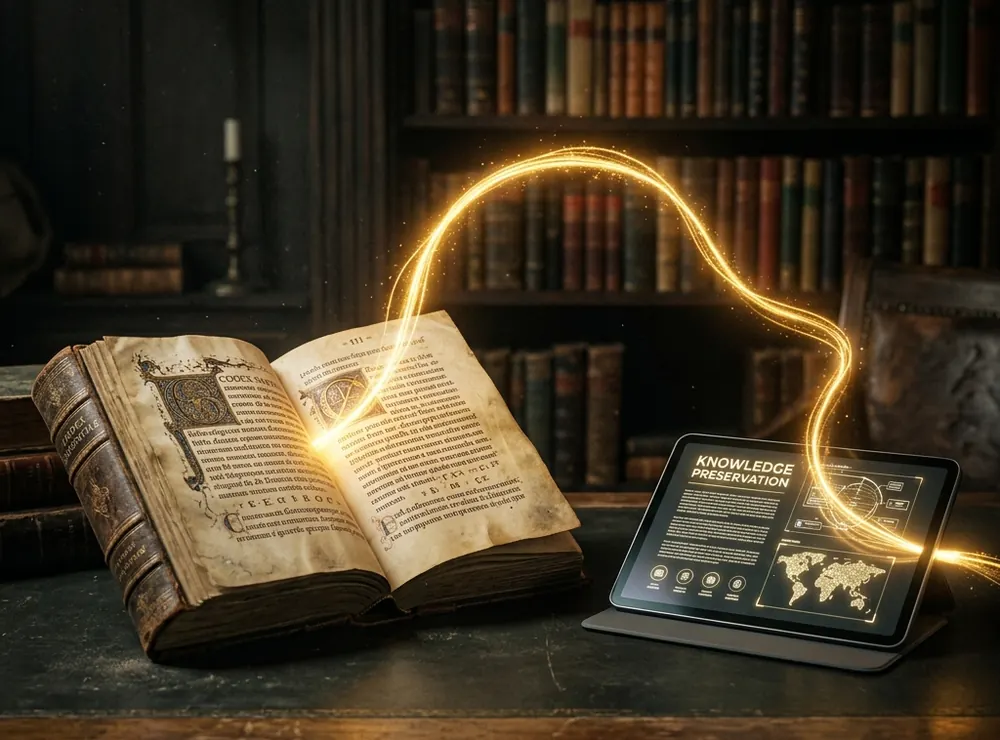
A thousand years later the problem has not changed, only the tools. A professor still has one lifetime and one calendar, and a course still deserves to outlast both. That is the work we do, and that is where the name comes from.